

Stop chasingmissing pages
Poppy checks each CPAP packet the day it arrives, then drafts one request to the referring office for your team to approve.
Start beside your current process. We do the setup, there is nothing to install, and there is no contract. We are early, so early partners get a heavily discounted rate and decide what we build first.
Missing pages cost you days
Medicare pays for CPAP only when the file proves the coverage rules were met. CMS found 12.5% of CPAP payments in error in 2024, about $146 million, and 71% of the errors for positive airway pressure devices were missing documentation. Every day a packet waits is a day before setup, and a day before the first rental payment. Source: CMS, 2024 Medicare Fee-for-Service Supplemental Improper Payment Data.
Know what is missing right away
Your staff see a plain list: what passes, what fails and why. A gap found on day one costs a phone call. The same gap found at billing can cost the claim, and Medicare can take back what it paid.
One request, not five calls
One documentation request to the referring provider lists every missing item. Fewer rounds of back and forth means less staff time per order and a shorter wait. Your staff approve it before it goes out by fax, text or email.
Next: follow every patient through the first 90 days
Medicare stops paying for the device and supplies after month three if the file lacks the adherence data and the re-evaluation. A visit after day 91 only restarts coverage on the visit date. We are building Poppy to track nightly use against the 4-hour rule and the visit window, then draft the request to the physician with the usage summary attached.
A paper trail for every result
Every result points to its source page. When a reviewer asks for proof of a paid claim, your staff open the page instead of searching the file.
Easy to start. Easy to stop.
We do the setup. You keep your current process. If it does not help, you stop.
Easy to start
Forward us a copy of your referral fax or email. We set it up with you and run the first packets. Nothing to install and no billing integration. We use made-up packets first. Real ones come only after a signed business associate agreement.
Worth your time and money
Missing documentation causes most CPAP payment errors. We record your waiting days and missing-document rate before we start, then show you what changed in plain numbers. We quote no savings in advance. Poppy is built to cut the calls and the rework.
Low risk
Your staff approve every message before it goes out. Nothing you do today changes. Setup is free. There is no contract, so you can stop at any point and owe nothing further.
Why join early
A heavily discounted rate. The founders work with you directly and build fast. Your daily problems decide what we build first, and what you ask for ships quickly. In return we ask for a few 30-minute calls and honest feedback.
Built for the people at your desk
Owners
See how many days your orders wait, and where. Set your own numbers and watch the gaps. Decide from your own baseline, not a guess.
Intake and order entry
Open a packet and see what is missing right away. Send one request instead of making five calls. Your staff approve every message.
Compliance and billing
Every result points to its source page. The checklist is written out and editable. Nothing leaves the building without a person approving it.
Count the days you wait
Where the days go is easy to guess and hard to see. Set your own numbers.
Where do the days go?
Example numbers. Move each slider to match one typical order.
Poppy works on the first two petals. It reads on arrival and drafts the request at once. The provider's office still takes the time it takes. Fewer waiting days means earlier setups and earlier billing. We measure cycle time and dollars against your own baseline before we change anything, and we quote no number until we have measured it with you.
How it works
First, read on day zero.
The fax, scan or upload is read the moment it lands. The written order, the face-to-face evaluation notes and the sleep test report are split and labelled.
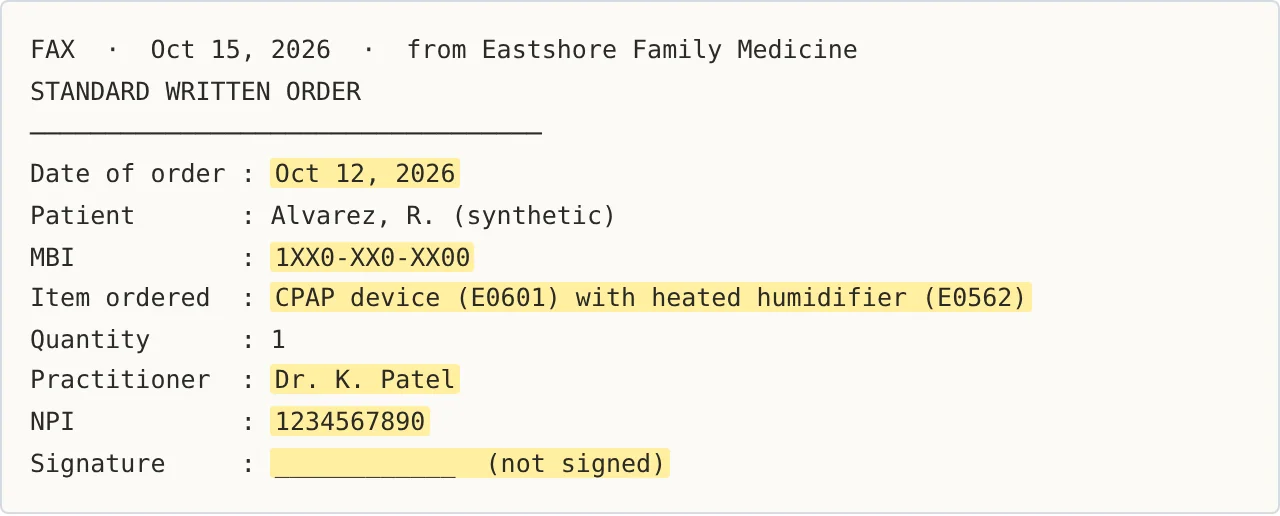
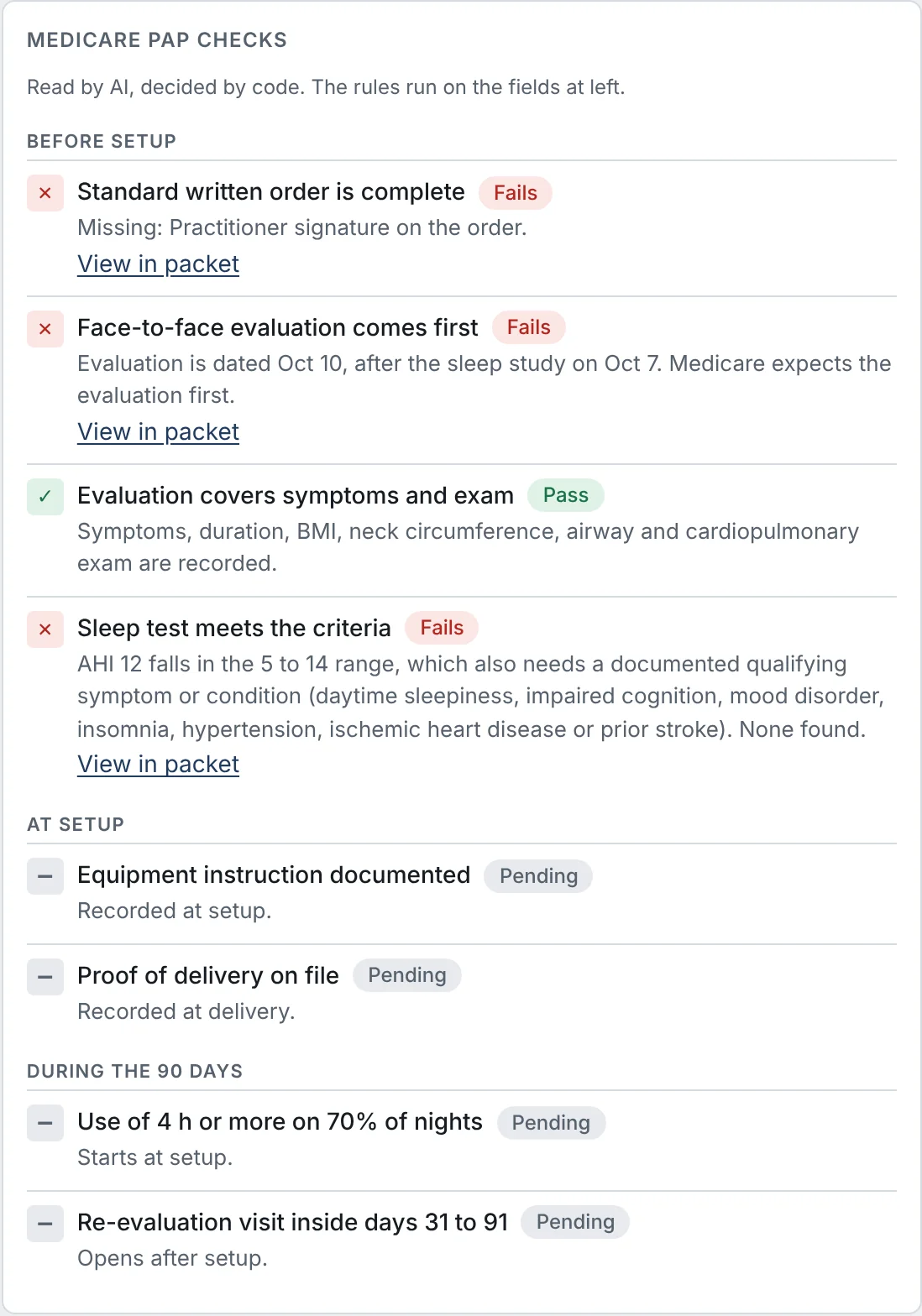
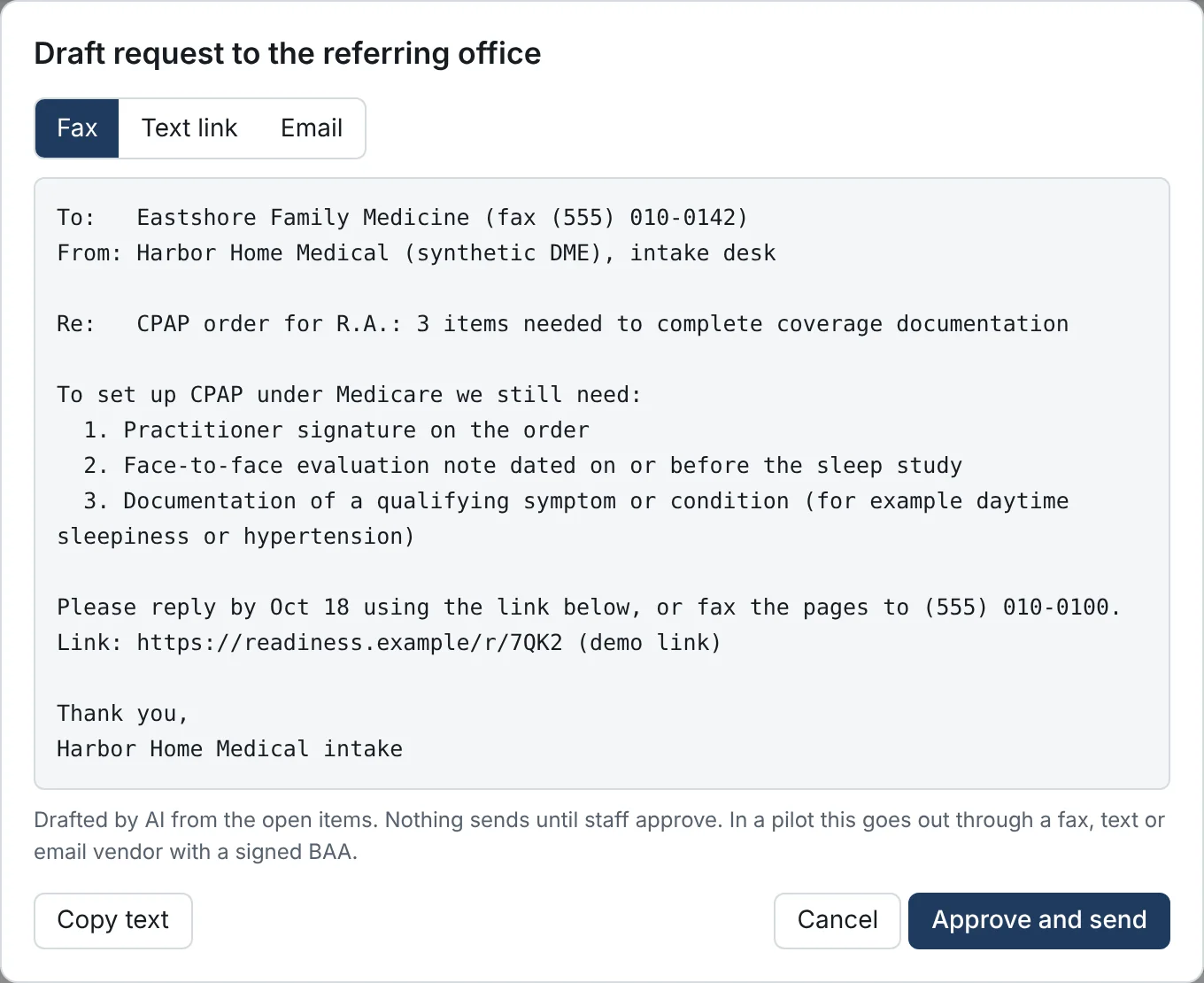
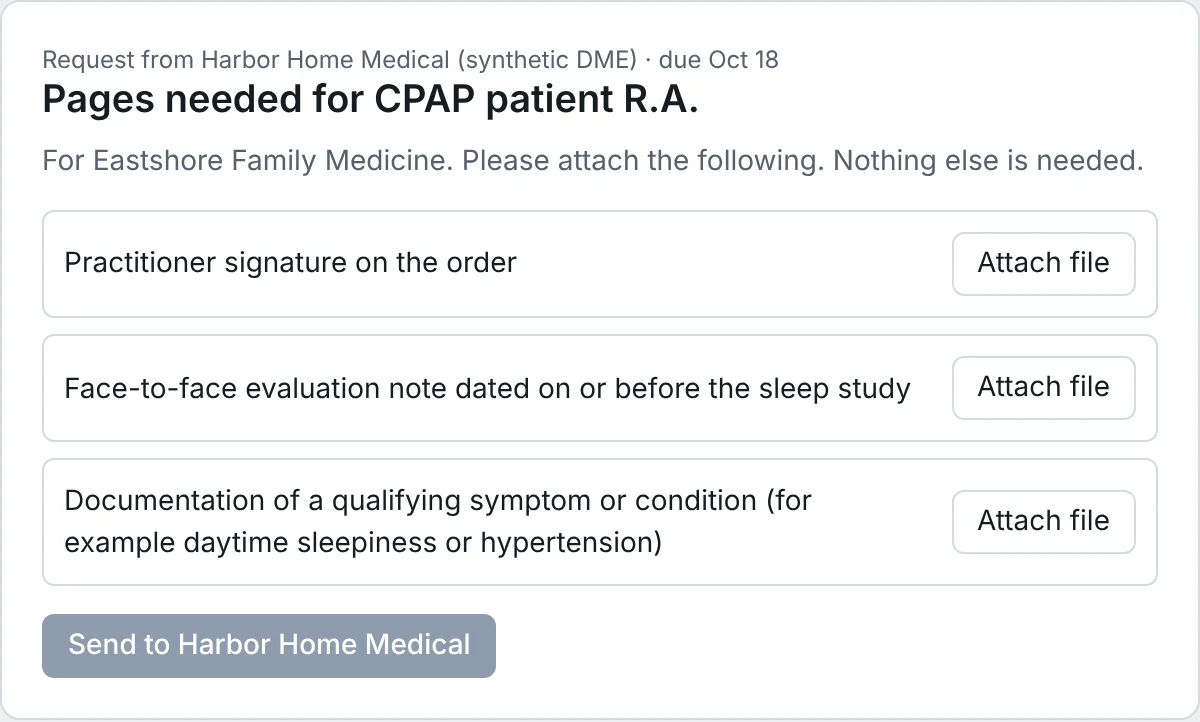
Sample screens. Patient details are fictional.
Try the checks
Poppy checks the rules that decide payment. Try four of them.
Source: LCD L33718 and Policy Article A52467.
When was the face-to-face evaluation?
Medicare wants the face-to-face evaluation before the sleep test. If it comes after, the file does not meet the coverage criteria. A packet check finds this on day one.
What did the sleep test score?
Medicare wants an AHI or RDI of 15 or more with at least 30 events. A score of 5 to 14 qualifies only with a documented condition. Hypopneas must be scored with a 4% oxygen drop, and the test must come from a lab or hospital, never from the supplier. This sketch assumes enough events.
How many nights of use?
In the first three months, Medicare wants 4 hours or more of use on 70% of nights in a 30-day period in a row. That is 21 of 30.
When is the re-evaluation?
An in-person visit from day 31 to day 91 after setup that documents symptom improvement and reviews the usage data.
Where Poppy is going
More of your CPAP orders set up and paid, with less staff time on each. Every feature has to move that.
Today
Check each order packet against Medicare PAP rules and ask the provider for every missing document at once.
Next
Follow each patient through the first 90 days: nightly use, the adherence rule and the re-evaluation visit.
Then
Show owners the cost of delay in dollars, from their own data: days waiting, claims at risk and staff hours per order, and which orders are stuck and why.
Always
A person on your staff approves anything that leaves the building. Early partners decide the order we build these in.
About Poppy
Poppy is early stage software for independent DME and sleep suppliers. It reads each CPAP order packet, checks it against Medicare's PAP rules and drafts one request to the referring office for everything that is missing. Your staff approve it before it goes out.
How we work with you
Early partners work with both founders directly. You email either of us, we set up a first 30-minute call, and we start with made-up packets. Real packets come only after a signed business associate agreement.
- Company
- Poppy
- Type
- Software for independent DME and sleep suppliers
- Stage
- Early stage. Not yet available to buy.
- Founders
- Elliot Berdy and Myles Baumann
- Offering
- Checks CPAP order packets against Medicare's PAP coverage rules and drafts documentation requests for what is missing. Next: follows each patient through 90-day adherence and the re-evaluation window.
- Payers
- Medicare fee-for-service first, using LCD L33718 and Policy Article A52467. Other payers can differ and are not built yet.
- Customers
- We are looking for a few early partners.
- Pricing
- Not set yet. Early partners get a heavily discounted rate, free setup and no contract.
- Patient data
- Made-up patients only today. Real data only after a signed business associate agreement.
- Headquarters
- San Francisco, California
Meet the founders
Poppy is built by two software engineers who have spent years on the billing side of healthcare.

Elliot Berdy, cofounder
Elliot is a software engineer with about four years in healthcare software. He grew up around medicine, and he wants to use software to help healthcare run better at scale.

Myles Baumann, cofounder
Myles is a software engineer and product manager with more than eight years in healthcare and financial software. He has worked with providers and payers on billing and practice management.
We have built healthcare billing software for years. Now we want to build this with the people who run CPAP intake every day.
Questions
What does Poppy do?
Do I need to connect my billing system?
What about HIPAA?
What does it cost?
Is it ready to use?
Be an early partner
Leave your email. We set up a first 30-minute call. Setup is free and there is no contract.
We will email you to set up a first 30-minute call and may ask a few questions about your intake desk. This form never needs patient information.